4.9 / 5

Over the past decade, many businesses have shifted their operations either partially or entirely online. Running a business digitally can help you get things done faster and reach a wider audience, but it also leaves you vulnerable to security threats like data breaches, malware, and phishing scams.
Many organizations hire a Chief Information Security Officer (CISO) to strengthen their security posture. However, for SMBs, hiring an in-house CISO may be out of budget. That’s where a virtual CISO, or vCISO, comes in.
With a vCISO, you get flexible, cost-effective cybersecurity support that can be tailored to your business’s needs. vCISOs provide valuable security leadership without the overhead of hiring a full-time executive. In this article, we’ll explore what a vCISO does and how they help growing organizations stay secure.
Key takeaways
- A Chief Information Security Officer (CISO) is an executive who handles a company’s cybersecurity and digital compliance strategy.
- A virtual CISO operates on a fractional or part-time basis, making security expertise more accessible to SMBs.
- vCISOs can help with developing security policies, incident response, employee training, security reporting, and more.
Understanding the core role of a CISO
With the prevalence of cyberattacks around the world, the role of a CISO has become essential for growing organizations. 100% of Fortune 500 companies employed CISOs in 2023. Let’s break down what a CISO does and why it’s so important.
What does a CISO do?
A CISO is responsible for managing an organization’s entire information and cybersecurity strategy. They conduct risk assessments to identify the organization’s vulnerabilities and implement policies, initiatives, and tools to address these vulnerabilities.
The CISO oversees ongoing data backups, penetration testing, and incident response to keep the organization running as safely and securely as possible.
When threats arise, it’s the CISO’s responsibility to communicate these risks to executive leadership and the board of directors. The CISO also works with the entire team to stay compliant with relevant industry regulations and legal frameworks. These could include HIPAA, CCPA, GDPR, or something else, depending on your industry and location.
Why is a CISO important?
A Chief Information Security Officer provides essential cybersecurity leadership for growing organizations.
As technology has advanced, cyberattacks have gotten more sophisticated and more frequent. Global cyberattacks increased by 47% between Q1 2024 and Q1 2025, highlighting just how sophisticated hackers have become in just one year.
Cyberattacks can have serious long-term consequences for your organization. Even a minor attack could disrupt your operations for days, hurting your productivity and profitability.
If critical data is exposed in a cyberattack, you could be subject to fines and lawsuits. Data breaches can also cause significant damage to your organization’s reputation.
A CISO provides expert guidance to help prevent these cyber threats. These professionals help you build a strong security and compliance program to proactively prevent these issues, rather than responding to them after the fact.
Watch this video to see how a vCISO can support your business
The rise of the vCISO: Addressing a critical need
CISOs play an essential role in their organizations by leading the entire security program. However, hiring a CISO can be challenging for SMBs with limited resources. The vCISO role has emerged to fill the gap, making security expertise accessible to a wider range of organizations.
The challenges of hiring a full-time CISO
CISOs are executive-level professionals who often have decades of expertise in the field. As a result, they often have high salary expectations. However, small businesses may not have the budget necessary to meet these expectations. Onboarding a new CISO also requires additional time and resources that growing businesses may not have.
On top of that, finding a CISO who aligns with your organization’s specific needs can be challenging. There is a limited number of qualified cybersecurity professionals on the job market, so your search might not yield the results you’re looking for.
Some SMBs also find that their need for CISO-level expertise fluctuates. Some weeks, they need expert-level cybersecurity support every day, but there are also weeks when their existing cybersecurity program runs on autopilot. In these situations, it’s difficult for smaller organizations to justify a traditional CISO role.
Introducing the vCISO as a solution
A vCISO provides a solution to these challenges. A vCISO works on a part-time or fractional basis, helping with specific projects or challenges as they arise.
vCISOs work with several clients at a time to provide flexible cybersecurity support. vCISOs can also scale with their clients, taking on more responsibility as the company grows and new challenges arise.
vCISOs bridge the gap for organizations that need an expert-level security professional but do not have the resources to support a full-time hire. These organizations can prioritize the vCISO services that are most important for continued cybersecurity and business success.
Key responsibilities and services of a vCISO
Although they may be working on a fractional basis, vCISOs still serve in a leadership role. They are responsible for driving the organization’s entire security culture and strategy to keep digital operations safe. Here are some of the key responsibilities of a vCISO.
Strategic security leadership
A vCISO is responsible for developing an organization’s entire security strategy based on business goals and the current threat landscape. This strategy will inform every decision that the security team makes moving forward.
This includes establishing security frameworks and best practices for employees to use in their day-to-day routines. The vCISO will also work with organizational leadership to invest in new technology and cybersecurity solutions.
Risk management and compliance
An effective cybersecurity strategy is not stagnant; it needs to be updated on a regular basis to account for new technologies and risk factors. vCISO must work with their security teams to conduct regular risk assessments and identify possible vulnerabilities.
When vulnerabilities are found, vCISOs implement risk mitigation strategies, ensuring the organization’s cybersecurity posture remains strong.
Additionally, vCISOs are responsible for cybersecurity compliance. Many organizations must use data protection measures to adhere to industry standards. For example, companies that work with healthcare data must comply with HIPAA.
Policy development and implementation
One of the biggest responsibilities for any vCISO is developing effective cybersecurity policies. Actionable security policies and procedures help everyone in the organization stay safe and secure when working online.
vCISOs work with key stakeholders to create policies that reflect the organization’s needs. They also help implement and enforce these policies.
Incident response planning and management
Even with a strong security strategy in place, incidents can still happen. vCISOs are responsible for developing an incident response plan and training the team on what to do when these incidents happen.
This way, the entire team can take action right away if something goes wrong, mitigating the damage.
In this scenario, the vCISO takes the lead with data recovery, breach notifications, and other response tactics. They are also responsible for post-event analysis to prevent the incident from happening again.
Security awareness training
All employees who work online should receive cybersecurity training, regardless of their role. In particular, employees should know how to spot and avoid phishing scams. One study found that 32.4% of employees are likely to click on suspicious links if they don’t receive proper training.
A vCISO is responsible for developing a strong security culture throughout the organization. This includes delivering training programs to educate employees on cybersecurity best practices, as well as regular assessments to test their knowledge.
Vendor risk management
Most organizations establish partnerships with third-party vendors as they grow. These partnerships can significantly increase productivity, but can also come with added cybersecurity risks.
vCISOs are responsible for assessing each vendor’s security posture to ensure they are safe to work with. They must also develop policies to protect the organization from security risks stemming from external partnerships.
Communication and reporting
vCISOs support leadership teams by communicating about the organization’s security posture, risks, and initiatives to shareholders. This includes creating and distributing regular security and compliance reports.
Benefits of hiring a vCISO
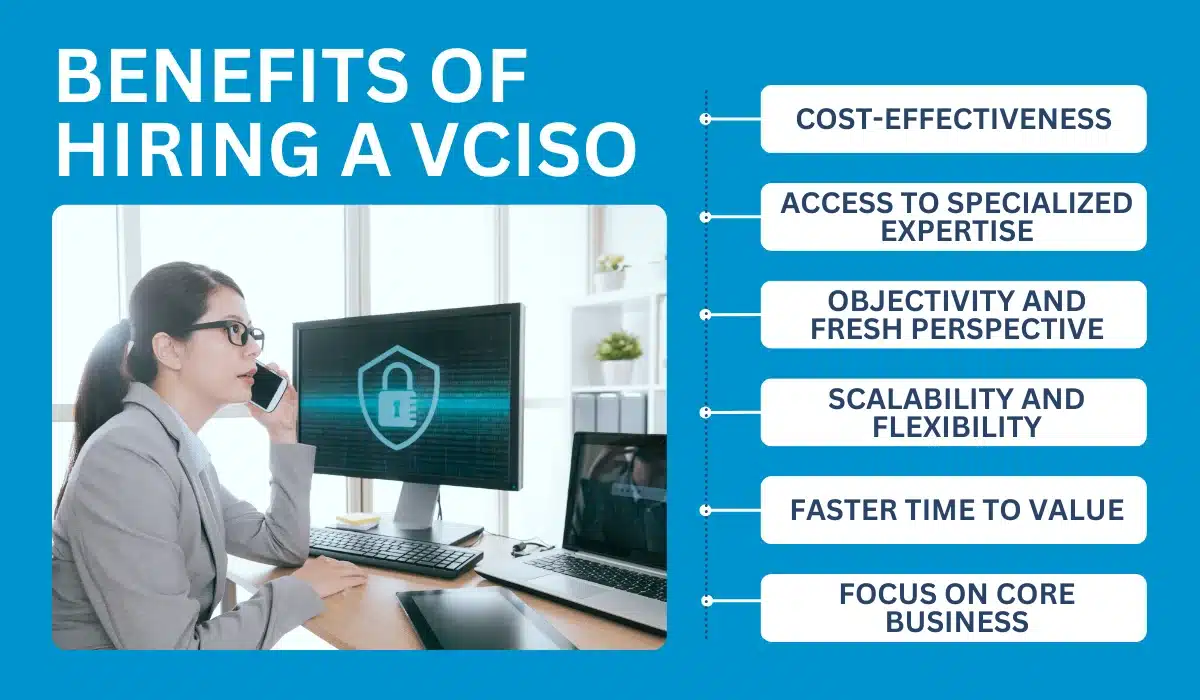
There are many benefits to hiring a vCISO for your organization, especially if you’re struggling to keep up with security management and regulatory compliance internally. Here’s why vCISOs are such an effective cybersecurity solution for SMBs.
Cost-effectiveness
Working with a vCISO provides significant savings when compared to the costs of hiring a full-time security expert. Instead of paying a hefty annual salary and benefits, you can collaborate with your vCISO to create a more flexible engagement model that works for both of you.
For example, a vCISO might charge a flat retainer fee for a limited number of hours each month. Organizations can then opt to add extra hours or projects at a pre-agreed rate to meet fluctuating demand levels.
The total cost is less than working with a full-time CISO, plus you can adjust the agreement based on your budget and cybersecurity needs.
Access to specialized expertise
vCISOs are usually seasoned cybersecurity professionals with decades of expertise. By hiring one, your organization gets access to a wealth of technical knowledge.
Having a vCISO on your team will help you avoid the latest cybersecurity threats, stay on top of recent security trends, and implement new technology.
Objectivity and fresh perspective
A vCISO provides a valuable external viewpoint, which is extremely helpful for problem-solving. With their unique perspectives, they can provide unbiased suggestions to help you improve your security measures. They can also help you catch vulnerabilities that your in-house team failed to spot.
Scalability and flexibility
vCISO services are flexible, so you can adjust them based on your organization’s changing needs. A vCISO can provide extra support when demands ramp up, with limited work obligations during slower periods.
Faster time to value
With their extensive cybersecurity expertise, vCISOs can start implementing new security improvements quickly, with minimal onboarding. They know how to integrate quickly with your team and hit the ground running right away.
Focus on core business
A vCISO will take many key cybersecurity tasks off your internal team’s plate. This allows your internal team to spend more time focusing on their core competencies, rather than putting out cybersecurity fires.
Why Diamond IT for your vCISO needs
Since 1997, Diamond IT has been providing IT, cybersecurity, and compliance services for growing organizations. We are a long-standing tech partner for companies throughout Central and Southern California, and we understand the unique challenges that local businesses face.
Our vCISO professionals are passionate about helping clients stay secure and compliant while meeting their business objectives. Our experts will work with you to develop a strategy that is tailored to your unique needs.
At Diamond IT, we approach each client’s business as if it were our own. We take a proactive approach to cybersecurity threats and compliance to ensure you’re prepared for any challenges that come your way.
Book a consultation today
With so many digital threats lurking, you need a cybersecurity leader your business can rely on. Partnering with a vCISO is a flexible, budget-friendly solution for growing organizations.
Diamond IT is your trusted partner for vCISO expertise and other reliable managed IT services. Book a consultation today to discuss your specific security needs and see how Diamond IT can help.