4.9 / 5


If you’re running a growing business, there’s a good chance you’ve felt the pressure from all sides of your IT operations. Maybe your in-house team is spending more time resetting passwords than planning improvements to your IT infrastructure. Perhaps you’ve lost sleep wondering how to cover cybersecurity without hiring another full-time specialist. Or maybe it’s the constant surprise expenses. One day it’s a server issue, the next it’s unexpected software downtime, and your IT budget is suddenly off track again.
You’re not alone. These challenges are common across industries, especially for small businesses trying to do more with limited resources. At a certain point, stretching your internal team thinner simply isn’t sustainable.
This is where outsourced IT support comes into play. It’s not just about plugging gaps. It’s a smarter, more strategic way to align your IT operations with your business goals. According to Forbes Technology Council, more organizations are turning to IT outsourcing to gain access to broader technical expertise while controlling costs. Instead of spending time and money hiring, training, and managing internal staff, businesses rely on experienced service providers with the tools and talent in place.
Outsourcing IT doesn’t mean sacrificing quality or giving up control. When done right, it means faster response times, proactive cybersecurity, and better uptime, all without the overhead of building a bigger IT department.
In this guide, you’ll learn how outsourced IT support works, where the most significant cost savings come from, and why the benefits of outsourcing extend far beyond just lowering your IT spending. You’ll also get a clear checklist for choosing an IT outsourcing provider who aligns with your business needs.
This guide will help you reduce disruptions, improve customer satisfaction, and free your team to focus on high-impact work.
Key takeaways
- Outsourcing IT transforms tech from a cost center into a strategic growth engine. By shifting support off your plate, you gain the focus and flexibility to drive performance, not just maintain systems.
- Predictable IT spending gives you control and confidence in your planning. Fixed-fee managed IT services help avoid budget blowouts and reduce financial guesswork.
- If your internal team is drowning in tickets, you’re burning time on the wrong priorities. Offloading help desk support allows in-house staff to focus on business growth instead of routine technical issues.
- Strong cybersecurity doesn’t require building an internal security team. The right IT partner delivers around-the-clock protection and compliance support without the overhead.
- Your business should scale without waiting for your IT department to catch up. Flexible IT support services help you adapt quickly to changing needs without long hiring cycles or growing pains.
Understanding Outsourced IT Support
Outsourced IT support isn’t just a stopgap or a vendor arrangement. It’s a strategic partnership where you bring in a managed service provider (MSP) to take ownership of specific IT functions, often the ones slowing down your internal team or stretching your budget thin.
This model gives you immediate access to proven processes, advanced tools, and a full bench of certified experts without the overhead of hiring, training, or managing an internal team. You stay focused on your business priorities while your provider handles daily support, performance monitoring, and critical incident response complexity.
Typical types of outsourced IT services
- Help desk and end-user support: Fast resolution for tickets, login issues, device troubleshooting, and day-to-day tech problems
- Infrastructure management: Support for on-site servers, cloud networks, backup systems, and secure remote access
- Cybersecurity services: Continuous threat monitoring, vulnerability assessments, incident response, and compliance-focused security measures
- Cloud management: Oversight of SaaS platforms, cloud migrations, license optimization, and resource allocation
- Specialized skills on demand: Access to Microsoft 365 experts, software developers, and niche technical talent when needed
Done right, IT outsourcing delivers the expertise and scalability of an enterprise-grade IT department at a fraction of the cost.
According to Statista, the global IT outsourcing market is projected to reach $591.24 billion in 2025, highlighting how many organizations are shifting to stay agile, secure, and competitive.
Significant Cost Savings with Outsourced IT Support
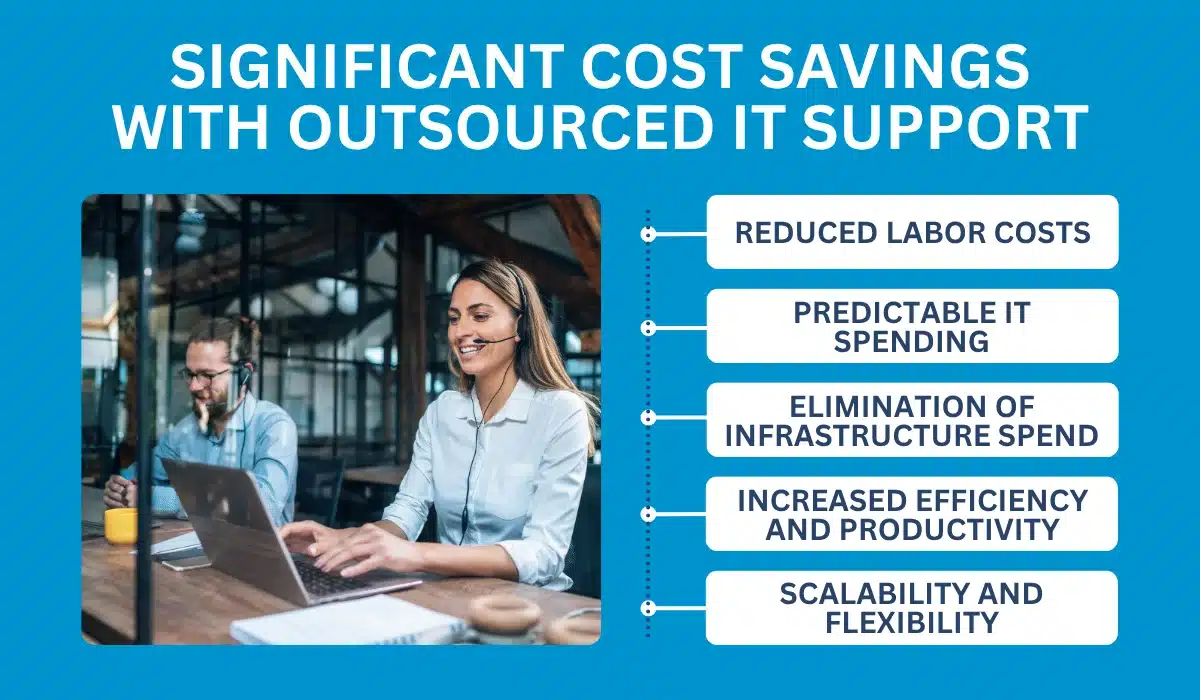
Outsourcing your IT support is one of the most strategic cost-saving decisions you can make. From eliminating hiring overhead to stabilizing your monthly IT spend, partnering with a managed service provider (MSP) helps you reduce operational friction while gaining better service and results.
1. Reduced labor costs
Salaries, health benefits, payroll taxes, recruitment, onboarding, and ongoing certification add up fast. Outsourcing converts those fixed expenses into a single monthly fee. Wipfli’s 2024 survey of 360 C-suite leaders found that access to deeper talent at lower cost is the #1 reason companies outsource.
2. Predictable IT spending
Most MSPs offer flat, per-user pricing. This allows you to budget confidently instead of reacting to surprises over time, support emergencies, or equipment failures. With SLAs in place, you know exactly what you’re getting and what it will cost.
3. Elimination of infrastructure spend
Moving infrastructure management or cloud oversight to a provider often removes the need for extra firewalls, backup appliances, or data-center racks. One Global FinTech company that outsourced development to a dedicated team cut costs by 40% and shipped new features three times faster.
4. Increased efficiency and productivity
Specialized engineers resolve issues more efficiently, reducing downtime and boosting customer satisfaction. In fact, 83% of Deloitte-surveyed executives expect third-party vendors to embed AI capabilities into their services.
5. Scalability and flexibility
Business needs evolve quickly. An MSP can scale your support up or down without the delays or costs of hiring. Whether launching a product or reducing headcount, your support adjusts without slowing you down.
Key Benefits Beyond Cost Savings
Outsourced IT support isn’t just about reducing spend. It’s about improving performance, protecting your business, and gaining capabilities your internal team can’t deliver alone. Here’s what you unlock when you treat outsourced IT as a strategic partnership, not just a service line item:
Access to specialized expertise
Hiring a full-time cybersecurity analyst, cloud architect, and SaaS administrator is rarely realistic for most teams. With outsourced IT services, you can access certified professionals across all these disciplines, ready to advise, troubleshoot, and optimize your systems. This level of technical expertise leads to better architecture decisions, faster root-cause resolution, and smarter technology investments over time.
Improved focus on core business
When your MSP owns the IT help desk, your internal team finally gets to focus on what drives growth. That might mean rolling out automation, improving customer-facing tools, or supporting expansion initiatives. When routine IT tasks are off your plate, your business can move faster, with fewer bottlenecks
Enhanced security and compliance
Cyber threats are relentless, and SMBs are often underprepared. Top-tier providers offer 24/7 cybersecurity monitoring, threat hunting, and built-in frameworks to address compliance standards like HIPAA, PCI-DSS, or SOC 2. You gain enterprise-grade security measures without the need to build them in-house.
Increased uptime and reliability
Proactive maintenance, patch management, and health checks keep systems stable and prevent failure before it happens. With SLAs in place, you’re guaranteed a rapid response and system availability that typically exceeds 99.9 percent, especially critical for industries that can’t afford downtime.
24/7 support availability
Whether it’s midday or midnight, a strong MSP keeps your systems running without interruption. This always-on access to customer support for e-commerce, healthcare, or global operations prevents delays, lost revenue, or client frustration.
Faster response and resolution
Outsourced support teams are built for speed. They live inside ticketing systems, resolve IT issues at scale, and often spot problems before you notice them. This reduces mean-time-to-repair and prevents minor incidents from becoming major disruptions.
Access to the latest technologies and best practices
Because MSPs work across many environments, they stay on the cutting edge of tools like automation platforms, AI-based monitoring, and advanced analytics. You benefit from ongoing optimization, improved IT management, and scalable solutions without spending more on tools or licensing.
Considerations When Choosing an Outsourced IT Support Provider
Not all outsourced IT support is created equal. The right provider should act as an extension of your team, not just a vendor you call when something breaks. Choosing a partner who aligns with your goals requires careful evaluation across several dimensions.
Start by defining your needs. Before engaging vendors, map out the systems, platforms, and responsibilities you want to offload. Are you seeking help desk support, full IT infrastructure management, or coverage for niche platforms like Microsoft 365 or cloud-based ERP systems? Be clear about whether you need compliance assistance (HIPAA, CMMC, SOC 2), support for hybrid work environments, or cybersecurity protections.
Do your homework on providers. Look for an MSP with a proven track record supporting businesses like yours that are similar in size, complexity, or regulatory profile. Review published service level agreements (SLAs) to understand what’s guaranteed and what’s not. Strong vendors are transparent about response times, escalation paths, and measurable outcomes.
Ask for references and real case studies. Speak directly with existing clients in your industry or operating at your scale. What was onboarding like? Did support meet expectations during high-stress moments? Solid references reveal whether the provider delivers more than sales promises.
Evaluate communication and cultural alignment. Technical chops matter, but communication is what keeps the partnership running. Your teams will interact regularly, so ensure the provider’s tone, responsiveness, and collaboration style match your company’s culture and expectations.
Dig into pricing models and contract terms. Clarify how fees are structured: per user, per device, or flat-rate? Understand variable costs like on-site visits, after-hours support, or project-based work. Review exit terms so you’re not locked into long-term commitments without flexibility.
Don’t overlook security and compliance readiness. Reputable MSPs should have documented protocols for incident response, audit support, and data management. Ask for certifications, SOC 2 reports, or proof of cybersecurity insurance. The right partner keeps your business protected and audit-ready.
Conclusion
Outsourced IT support is more than a budget solution. It’s a cost-effective strategy that helps you regain control of your technology, reduce downtime, and avoid growing risks like cyberattacks and compliance gaps.
With Diamond IT, you can access proactive IT management, expert help desk support, and responsive customer support that resolves technical issues before they disrupt your business.
Whether dealing with rising IT issues, stretched internal resources, or evolving IT needs, managed IT services can allow you to focus on what matters most: running and growing your business.
If you’re ready for IT that works for you, not against you, let’s talk. Diamond IT delivers dependable, cost-effective IT support services designed to keep your business secure, efficient, and always moving forward. Contact us today and take the first step toward smarter, stronger IT.