4.9 / 5

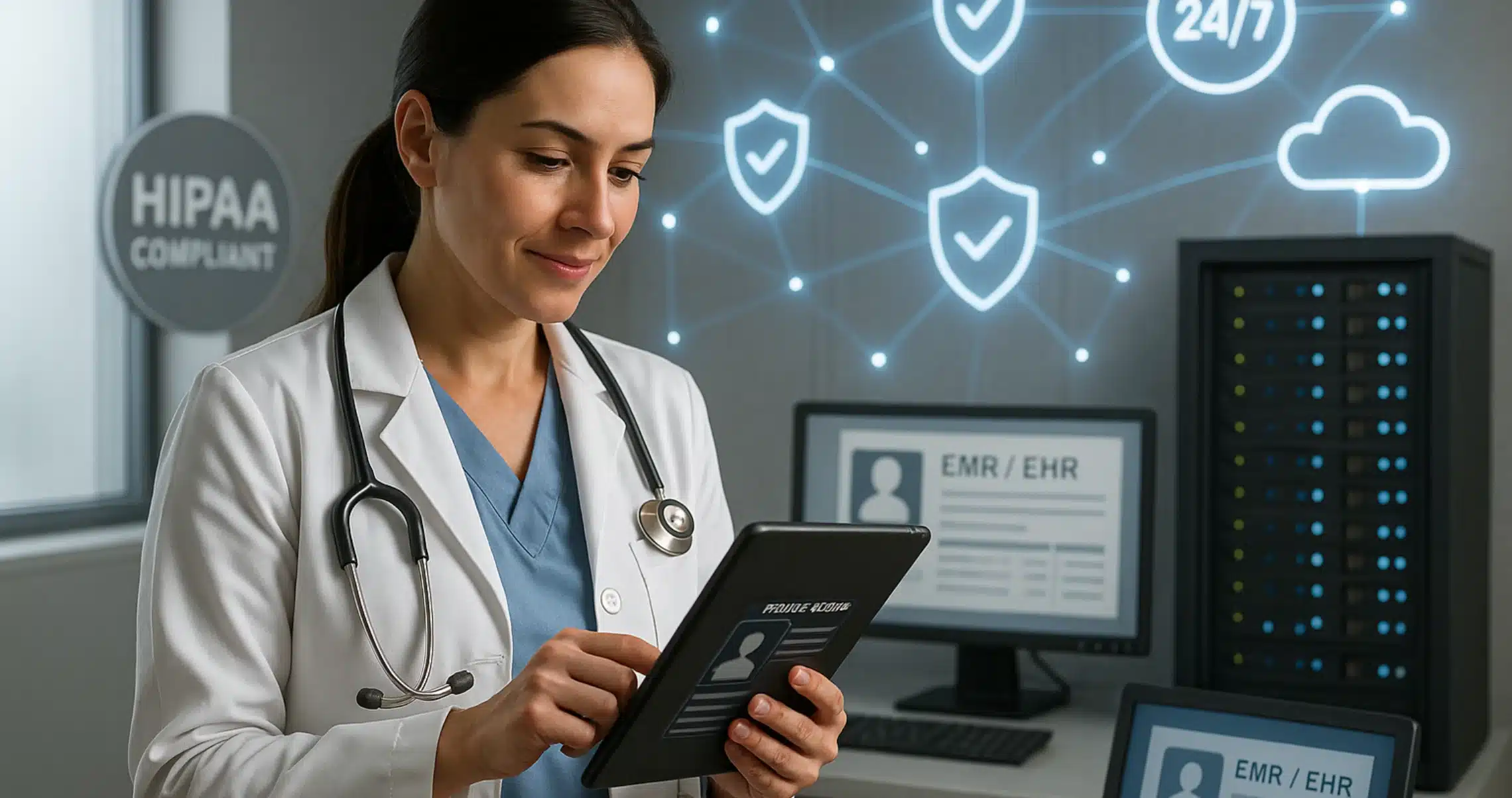
If you run a medical office, your technology needs to work flawlessly every hour, every day. A secure and efficient IT infrastructure protects patient care, privacy, and revenue. When systems fail, patients miss appointments, staff can’t access medical records, and your practice risks costly compliance violations.
Healthcare IT is under more pressure than ever. Already in 2025, the Department of Health and Human Services has launched 307 cybersecurity investigations, on pace to break last year’s record (Wall Street Journal). From ransomware attacks to outdated firewalls, the threats are evolving fast.
If you’re a provider, administrator, or manager facing complex IT challenges without a whole in-house team, this article is for you. You’ll learn precisely how managed IT services can help you protect patient information, minimize downtime, optimize workflows, and meet strict Health Insurance Portability and Accountability Act (HIPAA) standards.
We’ll cover how expert IT support, including help desk coverage, onsite assistance, cloud services, Electronic Medical Record (EMR) / Electronic Health Record (EHR) support, Microsoft 365 optimization, and timely system upgrades, can make a noticeable improvement.
Here’s how the right IT services can keep things running smoothly.
Key takeaways
- If you’re still relying on break-fix IT, you’re putting patient safety and compliance at risk. Proactive, healthcare-specific IT support helps prevent downtime, data loss, and HIPAA violations while offering more predictable costs than reactive fixes.
- Your most significant security risks aren’t just outdated software; they also include obsolete software. Untrained staff and unsecured access points can expose patient data; therefore, prioritize ongoing cybersecurity training and implement strict access controls, such as multi-factor authentication.
- You do not need a large in-house team to maintain uptime and protect patient information. A managed IT service provider can deliver enterprise-level security, automated backups, and 24/7 monitoring to keep your operations running.
- HIPAA compliance can become a strategic advantage, not just a regulatory hurdle. Strong data security practices build patient trust and position your practice as a modern, professional healthcare provider.
Why medical offices face unique IT challenges
Medical offices handle protected health information (PHI), making them prime targets for cyberattacks. In 2024, a total of 149 ransomware attacks on healthcare organizations were reported globally, with over half targeting the U.S. healthcare sector. Such threats present severe risks to patient safety, operational continuity, and regulatory compliance.
Compliance rules make things even harder. Medical offices must adhere to strict HIPAA rules, the Health Information Technology for Economic and Clinical Health (HITECH) Act, and various state privacy laws, which necessitate rigorous IT management standards.
If your practice fails to stay compliant, you could face steep penalties and legal trouble, as noted by the HIPAA Journal’s 2025 Annual Survey, which indicates that many organizations still struggle with developing robust privacy programs.
Moreover, healthcare providers depend heavily on electronic health records (EHRs), scheduling tools, and billing systems. When these critical systems fail, patient care suffers immediately. A report from HIT Consultant suggests that even brief downtimes can lead to substantial financial and operational disruptions, resulting in ripple effects throughout healthcare practices.
Healthcare IT environments are typically complex, often involving on-premises infrastructure, cloud solutions, medical devices, and numerous third-party vendors. The diverse mix of technologies increases vulnerabilities to common threats, such as phishing scams, insider errors, ransomware attacks, and outdated systems.
How managed IT services protect patient data
Managed IT services deliver comprehensive protection explicitly tailored for medical offices.
Data encryption (in transit and at rest)
Encryption keeps patient data unreadable, even if intercepted. Managed service providers (MSPs) implement industry-standard encryption protocols, significantly reducing the risk of breaches.
Secure backups and disaster recovery
Data backups prevent catastrophic data loss, ensuring business continuity and minimizing downtime. Disaster recovery plans enable critical systems to be brought back online quickly after cyberattacks or outages, thereby minimizing downtime and the impact of these events.
Endpoint security and patch management
Hackers often target individual devices with cyber threats. Endpoint security solutions, combined with consistent patch management, ensure vulnerabilities are closed before attackers can exploit them.
Access controls and multi-factor authentication (MFA)
Robust access controls limit who can view sensitive patient data. Implementing MFA provides an extra layer of security, drastically reducing the risk posed by compromised passwords.
Secure Wi-Fi and network segmentation.
Healthcare practices often manage multiple networks. MSPs ensure networks are segmented to isolate sensitive data from general use, reducing exposure from compromised devices.
Incident response and breach notification
A well-prepared incident response strategy enables medical offices to respond to breaches swiftly, thereby minimizing damage. Managed IT service providers also assist with breach notifications, keeping practices compliant with regulatory requirements.
Vendor and device security management
Managed services oversee the security of EHR systems, imaging devices, and third-party vendor technologies, ensuring all components meet strict compliance standards.
HIPAA compliance assistance
Regular risk assessments, documentation support, and compliance audits help medical offices stay aligned with HIPAA and other relevant regulations.
| Feature | Unmanaged IT | Managed IT |
|---|---|---|
| Data Encryption | Limited | Advanced |
| Regular Secure Backups | Occasional | Automated |
| Endpoint Security | Basic | Advanced |
| Access Control & MFA | Limited | Robust |
| Incident Response Planning | None | Comprehensive |
| Vendor Security Management | Limited | Proactive |
| HIPAA Compliance Support | Minimal | Extensive |
How managed IT improves uptime and efficiency
When your systems go down, patients and staff feel it immediately. Missed appointments, inaccessible patient records, and frustrated staff all lead to a poor patient experience and lost revenue. That’s why uptime and efficiency aren’t just nice to have; they’re non-negotiable.
Managed IT provides you with the tools and support to keep your operations running smoothly and efficiently. Here’s how:
Real-time monitoring and fast issue resolution
Around-the-clock system monitoring means your IT support team identifies and resolves issues before you even notice them. Real-time alerts, combined with expert troubleshooting, help resolve problems quickly and prevent bigger disruptions.
Proactive maintenance to prevent downtime
Regular software updates, performance checks, and system upgrades reduce the risk of unexpected outages. You’re not just reacting to IT problems; you’re preventing them.
Specialized support for medical devices and EMR systems
Managed service providers understand the specific requirements of EMR platforms, imaging equipment, and other clinical tools. Healthcare-savvy IT experts reduce disruption when syncing records or configuring clinical tools.
Streamlined workflows through automation
Automation reduces administrative burden. From automatic data backups to system patching and ticketing workflows, your practice saves time and increases productivity.
Backup and disaster recovery for business continuity
Reliable data backup systems and clear disaster recovery plans help your team recover quickly in the event of a disaster. Your patient data remains secure, and your operations get back online quickly.
A strong managed IT partner helps optimize your practice’s efficiency with the right mix of help desk support, onsite services, cloud services, and Microsoft 365 tools, all designed to maintain continuity and elevate the patient experience.
Keep your practice running confidently with Diamond IT.
Cybersecurity best practices for medical offices
When it comes to protecting sensitive data, every member of your team plays a role. Cybersecurity isn’t just about tools; it’s about policies and follow-through.
To strengthen your defenses, start with these best practices:
- Update and patch systems regularly to close security gaps before attackers find them.
- Train staff on cybersecurity basics like phishing awareness, password hygiene, and device security.
- Utilize robust access controls and multi-factor authentication to prevent unauthorized users from gaining access.
- Conduct routine IT audits to spot and fix vulnerabilities in your systems, devices, and network.
- Implement a business continuity plan that includes reliable data backup, disaster recovery, and clear steps for response in case of a breach.
Following these cybersecurity best practices helps protect your patient information, supports compliance, and reinforces trust with your community.
What to look for in medical IT services
Choosing a managed IT provider is a critical decision for your practice. You need more than just general tech support; you need a healthcare IT partner who understands the complexity of your environment.
Here’s what to prioritize:
HealthcaresSpecific expertise
Look for a provider with deep experience in the healthcare industry. They should understand HIPAA compliance, electronic medical records (EMRs), and the unique workflows of your team.
Comprehensive support for clinical systems
Your IT partner should support the systems you rely on daily, including billing software, scheduling platforms, imaging technology, and EMR systems. Bonus if they’re well-versed in Microsoft tools and cloud services.
Clear service level agreements (SLAs) and fast response times
Ensure your provider offers a service level agreement that includes guaranteed response times, real-time help desk support, and access to on-site technicians when needed.
Proven experience with practices like yours
Whether you manage one clinic or multiple locations, your provider should have experience with similar organizations and be able to scale as your IT needs evolve.
When you choose a medical IT service that understands your goals and workflow, you’re getting a strategic partner committed to helping your practice thrive.
Why medical practices choose Diamond IT
You’ve seen how the right managed IT support can protect your patient information, reduce downtime, and streamline operations in a way that genuinely supports your healthcare team. Whether you’re navigating HIPAA compliance, upgrading legacy systems, or simply trying to keep your EMR software and help desk from falling behind, having experienced IT experts in your corner can make all the difference.
Diamond IT understands the real-time demands of today’s healthcare industry. From secure cloud services to Microsoft optimization, firewall management, onsite support, and disaster recovery planning, we build IT solutions designed to optimize performance and safeguard patient care.
If you’re tired of wasting time on unreliable systems, reactive support, and constant compliance concerns, now is the time to upgrade. The right managed IT partner can transform how your medical office operates, giving you security, uptime, and support you can count on.
Schedule your free assessment today and discover what reliable, healthcare-specific IT support looks like. Your patients and your bottom line deserve it.
FAQs
What are managed IT services?
Managed IT services involve outsourcing IT management to experts who proactively monitor, secure, and maintain your technology infrastructure.
Why is HIPAA compliance substantial?
HIPAA compliance ensures patient data privacy and security, protecting healthcare providers from legal risks and fines.
Can managed IT help reduce downtime?
Yes, managed IT services utilize proactive maintenance, 24/7 monitoring, and swift issue resolution to significantly minimize downtime.
Are managed IT services cost-effective?
Yes, they provide predictable pricing, minimize expensive downtime, and reduce the need for in-house IT resources.